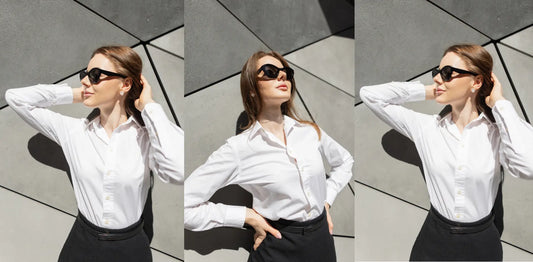
What Are Cat 3 Sunglasses? A Complete Guide to UV Protection

Cat 3 sunglasses have lenses that let through 8% to 18% of visible light, which means they block 82% to 92% of the brightness reaching your eyes. Category 3 is the most common rating for general-purpose sunglasses because it’s dark enough for strong sun at the beach, on the road, or around town, while still being suitable for daytime driving.
What the rating does not tell you is how much ultraviolet (UV) light the lens blocks. Lens category measures darkness only. UV protection is a separate specification, usually shown as UV400 or “100% UVA/UVB protection,” and you should look for both.
Where the “CAT 3” rating comes from
The 0–4 lens categories come from the international sunglasses standard ISO 12312-1, which is used across Europe, the UK, and Australia. That’s why you’ll often see “CAT 3” printed on the inner temple arm, sometimes next to a CE mark.
In the United States, the picture is slightly different. Non-prescription sunglasses are regulated by the FDA as Class I medical devices, and manufacturers commonly follow the voluntary ANSI Z80.3 standard, which covers optical quality, impact resistance, and UV transmittance. ANSI groups lenses into broader “cosmetic,” “general purpose,” and “special purpose” classes rather than numbered categories. Many brands sold in the US, including imported designs, still use the ISO category numbers because they’re easy for shoppers to understand.
For a US shopper, the takeaway is simple: “CAT 3” is a reliable shorthand for a dark, general-purpose sun lens, but it isn’t a substitute for a stated UV rating.
Sunglasses lens categories compared
| Category | Visible light let through | Light blocked | Best for | Daytime driving |
|---|---|---|---|---|
| Cat 0 | 80–100% | 0–20% | Fashion, indoors, very low light | Yes |
| Cat 1 | 43–80% | 20–57% | Overcast days, low sun | Yes |
| Cat 2 | 18–43% | 57–82% | Moderate sun, variable weather | Yes |
| Cat 3 | 8–18% | 82–92% | Bright sun, beach, water, everyday summer wear | Yes |
| Cat 4 | 3–8% | 92–97% | Glaciers, high altitude, extreme glare | No — not road-legal for driving |
None of the categories is suitable for night driving except Category 0, and even then only if the lens is close to clear.
Cat 2 vs Cat 3
Cat 2 lenses are a good choice if you live somewhere with frequent cloud or you move between shade and sun all day. Cat 3 is the better fit for consistently bright conditions: summer in the South and Southwest, long highway drives, or days near water and sand, where reflected light adds to the glare.
Cat 3 vs Cat 4
Cat 4 lenses are built for extreme light, such as snowfields or high-altitude hiking. They’re so dark that they make it hard to read traffic signals and see into shadows, which is why ISO 12312-1 marks them as unsuitable for driving. For almost everyone at sea level, Cat 3 is the darkest lens you need.
Cat 3 vs UV400: why darkness isn’t the same as UV protection
This is the most common misunderstanding about sunglasses, and it matters for your eye health.
Lens category measures visible light. UV400 measures ultraviolet light, the invisible radiation linked to cataracts, growths on the eye, and photokeratitis (a sunburn of the cornea). A lens can be very dark and still let UV through, or be lightly tinted and block 100% of it.
A dark lens without proper UV filtering can actually be worse than no sunglasses at all. Behind a dark tint your pupils open wider, which lets more unfiltered UV reach the inside of the eye.
The American Academy of Ophthalmology recommends sunglasses that block 99–100% of UVA and UVB rays, and notes that a “UV400” label and a “100% UVA/UVB” label mean the same level of protection. It also points out that darker lenses don’t automatically block more UV, and that a higher price doesn’t guarantee better protection.
What to look for: CAT 3 and UV400 (or 100% UVA/UVB) stated together on the label or product page. If you’re unsure about a pair you already own, most optical shops can test it with a UV meter in a few seconds.
Are Cat 3 sunglasses polarized?
Not necessarily. Polarization is a third, separate feature.
A polarizing filter blocks horizontally oriented light, which is the glare that bounces off water, wet roads, car hoods, and windshields. It sharpens contrast and reduces squinting, but it doesn’t change the lens category or add UV protection on its own.
So a pair of sunglasses can be:
- Cat 3 only: dark enough for bright sun, no glare filter.
- Cat 3 + UV400: dark, with full UV filtering.
- Cat 3 + UV400 + polarized: dark, UV-filtering, and glare-reducing, which is the most versatile combination for driving and time near water.
Quick polarization check: Look at your phone or a car dashboard screen through the lenses and slowly tilt your head about 60–90 degrees. If the screen darkens noticeably, the lenses are polarized. The flip side is that polarized lenses can make some screens and head-up displays harder to read at certain angles, so test them in your own car.
If you want to go deeper on glare reduction specifically, see our guide to polarized UV400 sunglasses.
Are Cat 3 sunglasses good for driving?
Yes, for daytime driving. Category 3 is the darkest category considered suitable for the road, and it’s what most driving sunglasses use. A few practical points:
- Never drive at night in Cat 3 lenses. They block too much light for dusk, night, or heavy overcast.
- Take them off in tunnels and parking garages if the sudden darkness makes it hard to see.
- Neutral gray or brown tints keep traffic-light colors most accurate. Very strong colored or mirrored tints can distort them.
- Polarization helps with glare from wet roads and the car ahead, but check your dashboard screen as noted above.
When to wear Cat 3 sunglasses (and when not to)
| Situation | Is Cat 3 right? |
|---|---|
| Sunny commute or road trip | Yes |
| Beach, pool, or boating | Yes, ideally polarized for water glare |
| Hiking or golf in full sun | Yes |
| Overcast or rainy day | Often too dark; Cat 1–2 is more comfortable |
| Skiing, glacier travel, high altitude | Consider Cat 4 (but not for driving) |
| Dusk, night, or indoors | No |
One thing to keep in mind on cloudy days: UV rays still pass through cloud. Even if you switch to a lighter lens, keep it UV400.
How to tell if your sunglasses are Cat 3
- Check the inner temple arm. Many brands print “CAT 3” or “Cat.3” there, sometimes with a CE mark.
- Check the product page or hang tag. Look for “Category 3,” “CAT3 lenses,” or a visible light transmission (VLT) figure between 8% and 18%.
- Don’t judge by eye. Lens color, mirror coatings, and gradients make lenses look darker or lighter than they are. If there’s no rating listed, ask the seller.
Other specs worth checking alongside Cat 3
Lens material. TAC (tri-acetate cellulose) lenses are lightweight and widely used for polarized lenses because they offer good optical clarity. Polycarbonate lenses are more impact-resistant and a better pick for sports. Neither material is a UV rating on its own, so still look for UV400.
Frame material. TR90 is a flexible, lightweight nylon-based material that holds up well to everyday knocks. Metal frames such as aluminum or zinc alloy feel more structured and premium. Frame material affects comfort and durability, not lens protection.
Fit and coverage. UV and glare can sneak in around the edges. Larger lenses and close-fitting or wraparound frames give more coverage. Our fitting guide explains how lens width, bridge width, and temple length affect fit.
Cat 3 sunglasses at PROGLASSES
At PROGLASSES, our polarized styles list the lens category, UV rating, and lens material on each product page, so you don’t have to guess. Two examples:
- Credo N716 Polarized TR90 Sunglasses: a lightweight full TR90 frame with polarized TAC lenses, UV400 protection, and a CAT3 lens rating, designed with driving and travel in mind.

- Glamour N7824 Polarized Cat Eye Sunglasses: a women’s cat-eye shape with a zinc alloy frame, TR90 temples, polarized TAC lenses, UV400 protection, and a CAT3 rating.

You can browse more styles in the men’s sunglasses collection and women’s sunglasses collection. If you’re ready to compare specific models, our Cat 3 polarized UV400 buying guide breaks them down by driving, style, and everyday use.
Frequently asked questions
What does Cat 3 mean on sunglasses?
Cat 3 means the lenses let through 8–18% of visible light, blocking 82–92% of brightness. It’s a darkness rating from the ISO 12312-1 standard and is intended for bright sunlight.
Do Cat 3 sunglasses block UV?
Not automatically. Cat 3 only describes how dark the lens is. Look for a separate UV400 or 100% UVA/UVB label to confirm UV protection.
Is Cat 3 or Cat 4 better?
For everyday use, Cat 3. Cat 4 is only needed for extreme glare such as snowfields or high mountains, and Cat 4 lenses are not suitable for driving.
Can you drive with Cat 3 sunglasses?
Yes, during the day. Cat 3 is the darkest category suitable for driving. Don’t wear Cat 3 lenses at night, at dusk, or in very low light.
Are all Cat 3 sunglasses polarized?
No. Polarization is a separate glare-reducing filter. Many Cat 3 sunglasses are polarized, but you need to check the product details.
Can I wear Cat 3 sunglasses every day?
Yes, in bright weather. On overcast days a lighter Cat 1 or Cat 2 lens may be more comfortable, but keep UV400 protection either way.
What is the difference between Cat 2 and Cat 3 sunglasses?
Cat 2 lets through 18–43% of visible light and suits moderate or changeable sun. Cat 3 lets through 8–18% and suits strong, consistent sunlight.
The bottom line
Cat 3 tells you a lens is dark enough for bright sun and still fine for daytime driving. It doesn’t tell you about UV protection or glare. For most people in sunny conditions, the ideal pair combines three specs: Cat 3 for brightness, UV400 for eye health, and polarization for glare. Check all three, then pick the frame that fits you best.
Sources: American Academy of Ophthalmology — How to choose the best sunglasses; AAO — Recommended sunglasses types; ISO 12312-1 (sunglasses for general use); ANSI Z80.3 (US non-prescription sunglasses standard).